


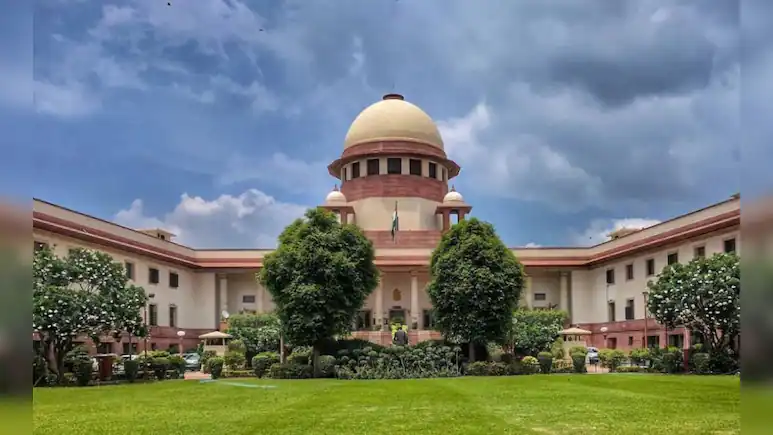
The Supreme Court on Tuesday declined to entertain a plea seeking the cancellation of the All India Majlis-e-Ittehadul Muslimeen’s (AIMIM) registration as a political party. While doing so, the apex court made a strong observation, stating that political parties relying on caste-based considerations are equally dangerous for the country.
A bench comprising Justices Surya Kant and Joymalya Bagchi emphasized that AIMIM’s stated objectives align with the Constitution. According to the party’s constitution, it aims to serve all backward sections of society, including minorities.
“The party claims it will work for every backward class, including Muslims who are economically and educationally disadvantaged. This is in accordance with what our Constitution envisions,” the bench told advocate Vishnu Shankar Jain, representing the petitioner.
The judges noted that constitutional provisions grant specific rights to minorities, and a political party committing to the protection of these rights is acting within legal bounds. The bench also advised Jain to withdraw his petition challenging the Delhi High Court’s decision to uphold AIMIM’s registration and recognition by the Election Commission (EC).
Instead, the bench granted liberty to the petitioner to file a broader plea for electoral reforms. “There may indeed be grey areas, where a political party, despite assurances, stirs religious sentiments during campaigns. But such cases must be brought before the appropriate legal forum,” the court observed.
The bench underlined the dangers of caste-based politics, equating it with communal rhetoric. “There are political parties that rely on caste considerations—this is just as harmful to national unity. A broader, neutral petition on electoral reforms would be more effective,” the court advised.
Petitioner Tirupati Narasimha Murari, represented by Jain, alleged that AIMIM promotes Islamic education and encourages Muslims to follow Sharia law. Responding to this, Justice Surya Kant said, “Teaching Islamic education is not inherently wrong. In fact, we welcome the establishment of more educational institutions by political parties.”
When Jain argued there is discrimination against Hindu-focused political efforts, claiming that teaching the Vedas or Upanishads would face objections, the court dismissed this concern. “If the EC objects to teaching ancient Hindu scriptures, the appropriate legal channels are available to challenge that,” Justice Kant said.
He further added, “There’s nothing illegal or unconstitutional about teaching historical texts or religious literature. However, if a political party promotes untouchability, that’s unconstitutional and must be prohibited. Promoting religious education, on the other hand, is not forbidden.”
The bench reiterated that actions must be assessed within the constitutional framework. “If a religious law is protected under the Constitution and a party wants to teach it, they are within their rights,” the court clarified.
Earlier this year, on January 16, the Delhi High Court’s division bench dismissed the petition against AIMIM’s registration. It upheld a prior decision by a single-judge bench that ruled the plea was meritless and infringed on the fundamental rights of AIMIM members to form a political party and advocate for their beliefs.