


India finds itself at the crossroads of a complex geopolitical triangle involving China, Russia, and the West. Recent developments have reignited a crucial debate: can India help reduce Russia’s growing dependence on China — and more importantly, should it?
Last week, at a Federation of Indian Chambers of Commerce and Industry (FICCI) event, Lieutenant General Rahul R Singh, Deputy Chief of Army Staff, made a striking revelation. He confirmed that China had directly supported Pakistan during India’s Operation Sindoor, referencing the use of the ancient Chinese strategy of the “borrowed knife” — a metaphor for using a proxy to weaken an adversary.
While India has long known of China’s close military ties with Pakistan — including Beijing’s decision to supply dozens of 5th-generation fighter jets — such a direct accusation from a senior Indian officer was unusual. It marked a rare moment of public candor in India’s typically cautious strategic discourse.
A Lukewarm Western Response
Singh’s remarks came just after Pakistani military chief Asim Munir was hosted by U.S. President Donald Trump at the White House, underscoring Washington’s ongoing balancing act between New Delhi and Islamabad. Despite the Pahalgam terror attack, which prompted an Indian military response, major global powers failed to unequivocally support India. While the West condemned the attack, they fell short of backing India’s right to retaliate — even as evidence of Chinese support for Pakistan was mounting.
This diplomatic restraint frustrated many Indians. New Delhi’s two-decade effort to build stronger ties with the West appeared to have limited payoff when it mattered most.
The China-Pakistan-Russia Axis — A Challenge for India
The increasing military nexus between Pakistan and China demands a recalibration of India’s strategic partnerships. One option: revive and reinforce its historic ties with Russia.
Though Moscow’s recent response to India’s actions was similar to that of the West, Russia has traditionally stood by India — notably during the 1971 war, and again after India’s nuclear tests in 1974 and 1998, when it resisted Western pressure to isolate New Delhi.
Today, Russia’s own geopolitical positioning has changed dramatically due to its war in Ukraine. Cut off from much of the West, it has drawn closer to China — but not necessarily by choice.
Russia’s Growing Dependence on China — And the Limits
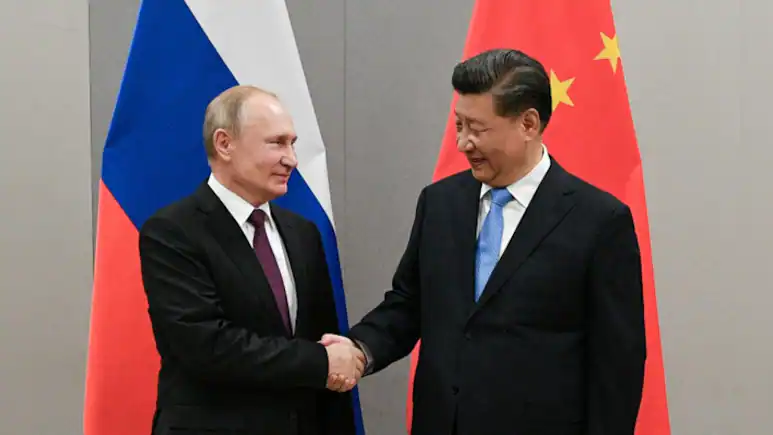
Since Xi Jinping and Vladimir Putin declared a “no-limits” partnership just weeks before Russia’s invasion of Ukraine, Moscow has leaned heavily on Beijing. China has reportedly supplied critical components for Russian weapons manufacturing — from drones and microelectronics to machine tools and nitrocellulose.
However, this partnership is not without friction. A leaked report from Russia’s FSB intelligence agency, published by The New York Times, labeled China as a long-term strategic threat. The FSB accused Beijing of attempting to steal Russian military secrets, infiltrating intelligence operations, and even encroaching on Russian territory in the Pacific and Arctic.
This internal skepticism suggests there may still be room for India to nudge Moscow away from Beijing’s grip — especially as the Russia-China alliance increasingly resembles a relationship of convenience, not deep trust.
India’s Advantage: Trust and Technological Cooperation
Russia continues to offer India high-end military technology — often on terms far more generous than those of the West. A case in point: the Su-57 fifth-generation stealth fighter, which Russia is now willing to co-produce in India, complete with source code and technology transfer — a level of transparency the U.S. has consistently denied, even with friendly nations.
Furthermore, India and Russia have long co-developed projects like the BrahMos cruise missile, and discussions are reportedly underway for joint production of the advanced S-500 missile defense system, following the successful deployment of the S-400 against Pakistan.
Despite diversifying its defence procurement, India still sources a majority of its systems from Russia — a reality that underscores the depth of their strategic engagement.
Xi Jinping’s Worry: Losing Putin to the West or India
As former U.S. President Donald Trump ramps up efforts to mediate peace in Ukraine, one of his stated goals is to “un-unite Putin and Xi.” The rationale: a weakened Russia, once disentangled from its overreliance on China, could balance the Beijing threat more effectively — a sentiment shared by many in Washington.
Xi is fully aware of this danger. A post-war Russia, no longer bogged down by sanctions or conflict, could restore ties with the U.S. and strengthen cooperation with India — thereby diluting China’s influence. The war, therefore, serves Beijing’s interests by keeping Russia dependent and isolated.
In fact, China-Russia trade hit a record $245 billion in 2024, a 66% increase since 2021. Most of this growth came from China exporting dual-use technology — further embedding Moscow in Beijing’s industrial supply chain.
Should India Try to Pull Russia Away?
India has a clear incentive to limit China’s strategic reach. A more balanced Russia, free from Beijing’s shadow, could not only rebalance Asian geopolitics but also bolster India’s own defense ecosystem.
Yet the road is complicated. Any deepening of India-Russia ties could be viewed with suspicion in Washington, particularly at a time when the U.S. sees Russia as a persistent security threat. But India has always walked a fine line — maintaining strategic autonomy without entering formal alliances.
India’s message to the West must be consistent: unlike China, India does not seek to challenge the global order. It wants to ensure that no single power — especially China — becomes dominant in the Indo-Pacific or Eurasia.
Conclusion: A Strategic Tightrope
India’s task is delicate. It must maintain robust ties with the United States — the only credible power that can counter China — while also deepening its historical relationship with Russia.
With Putin increasingly wary of Xi, and Beijing itself cautious of Moscow’s long-term intentions, there is an opening. India can use this opportunity to forge deeper defense and diplomatic ties with Russia, not to undermine the West, but to weaken China’s strategic stranglehold.
As the balance of power continues to shift, India’s role as a neutral but influential player could shape a new geopolitical equilibrium — one where strategic autonomy is not just preserved, but leveraged.