


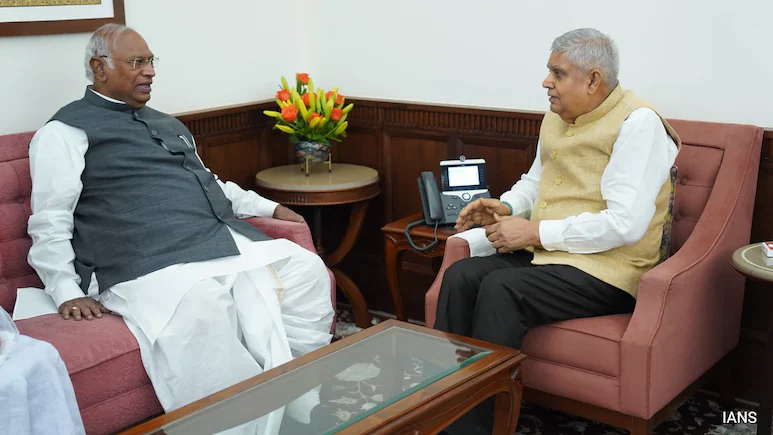
In a political development that has sparked widespread debate, Vice President Jagdeep Dhankhar’s sudden resignation has been met with skepticism from key opposition leaders, particularly Congress President and Rajya Sabha LoP Mallikarjun Kharge. His remarks indicate that the resignation may not be as straightforward as claimed.
Addressing reporters on Wednesday, Kharge voiced his doubts openly.
“The government must explain the real reason behind Dhankhar’s resignation. I sense something is amiss — ‘dal mein kuch kaala hai’,” Kharge said. “His health seemed fine, and he was known to staunchly defend the RSS and BJP. So why resign now?”
His comments highlight a growing concern within the opposition ranks — that Dhankhar’s resignation may be politically motivated, rather than being based solely on health concerns as stated.
Political Undertones Revealed?
The narrative gained further traction when Congress MP Gaurav Gogoi, Deputy Leader of Opposition in the Lok Sabha, took a sharp jab at Prime Minister Narendra Modi over his response to the resignation.
In a post on X (formerly Twitter), Gogoi remarked:
“The dignity of a Constitutional post must be upheld — both while serving and while resigning. PM Modi’s tweet hints at the political nature of Dhankhar’s resignation.”
This response came after PM Modi posted a carefully worded message:
“Shri Jagdeep Dhankhar Ji has had many opportunities to serve our country in various roles, including as the Vice President of India. Wishing him good health.”
Health Reasons or Political Calculations?
Dhankhar submitted his resignation late Monday, citing medical advice and the need to focus on his health. On Tuesday, BJP MP Ghanshyam Tiwari, a member of the panel of vice-chairpersons, formally announced the resignation in the Rajya Sabha, stating that the Ministry of Home Affairs had notified it under Article 67A of the Constitution.
The timing of the resignation — just as the Monsoon Session of Parliament began — has further intensified suspicion. Political analysts and several opposition leaders argue that the Jagdeep Dhankhar resignation controversy could have deeper implications.
Opposition Demands Transparency
Opposition leaders are demanding that the central government come clean about the real motives behind the Vice President’s exit.
“Why now? What happened behind closed doors? There’s more than meets the eye,” remarked another senior Congress leader under anonymity.
What Happens Next? The Vice President’s Succession
The resignation creates a sudden vacancy in the office of the Vice President of India, who also serves as the ex-officio Chairman of the Rajya Sabha. According to constitutional provisions:
-
The Vice President is elected by an electoral college consisting of members from both Houses of Parliament.
-
Voting is held via secret ballot through proportional representation using the single transferable vote method.
-
When a vacancy arises due to resignation, death, or removal, elections must be conducted promptly to fill the office.
-
The newly elected Vice President serves a full five-year term starting from the date they assume office.
This development means that the country could soon witness an intense political contest over who will take over one of the most significant constitutional posts in India.
Speculations and The Road Ahead
While the ruling government maintains that Dhankhar’s resignation is purely for health reasons, the opposition believes there’s a strategic political play involved — potentially reshuffling power or setting up key figures ahead of the 2026 general elections.
As the Jagdeep Dhankhar resignation controversy continues to unfold, citizens and political observers alike are demanding transparency and accountability from those in power.
Conclusion: A Nation Awaits Clarity
With no clear answers and plenty of political buzz, Mallikarjun Kharge’s remarks and opposition concerns are likely to keep the controversy alive in the days to come. Whether the resignation was a personal choice or a calculated political maneuver remains to be seen — but one thing is certain: India’s political landscape is set for yet another high-stakes chapter.