


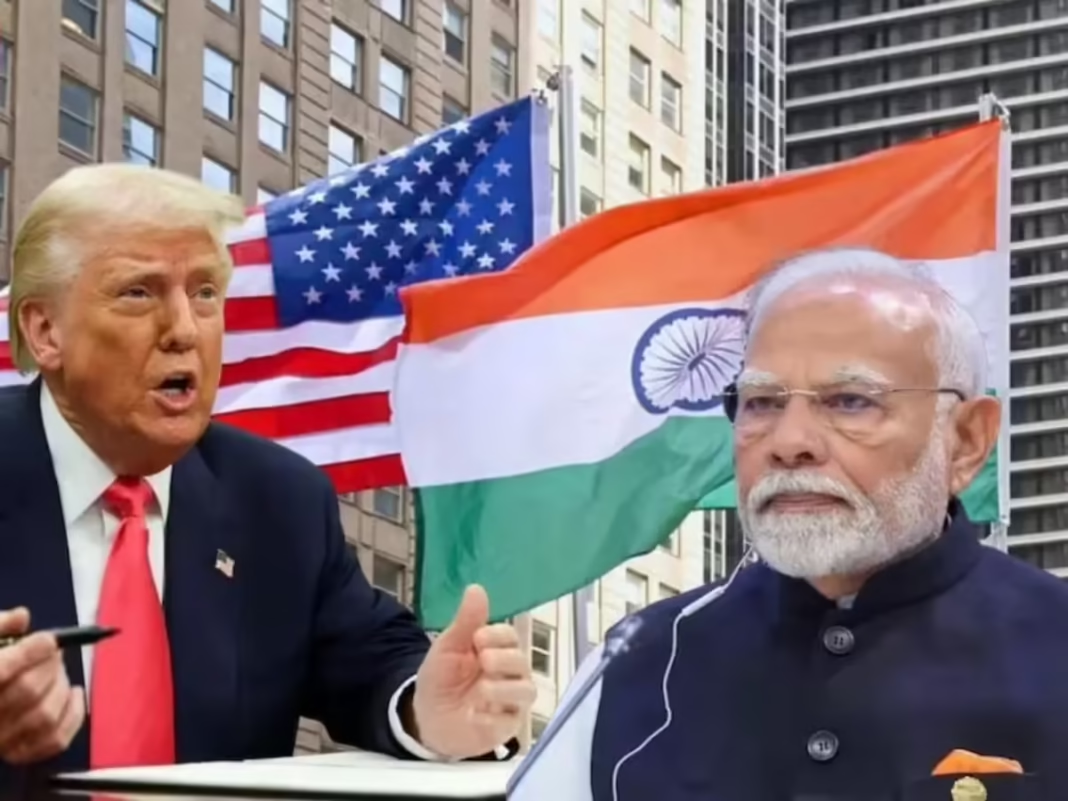
US President Donald Trump on Tuesday reaffirmed that a trade deal between India and the United States is on the horizon, emphasizing a future agreement that involves “much less tariffs” and fairer competition between the two nations.
“I think we are going to have a deal with India. And that is going to be a different kind of a deal,” Trump said. “It is going to be a deal where we are able to go in and compete. Right now, India does not accept anybody in. I think India is going to do that, and if they do that, we are going to have a deal for much less tariffs.”
Both countries have been locked in negotiations over a Bilateral Trade Agreement (BTA), aiming to reach an interim deal before the critical July 9 deadline — the end of a 90-day pause on tariff escalations.
Sources indicate that India is taking a firm stance on sensitive agricultural issues as the talks intensify. The Indian delegation, led by Chief Negotiator Rajesh Agrawal, has extended its stay in Washington, D.C., as the negotiations — originally scheduled for Thursday and Friday — have been prolonged in a bid to finalize the interim agreement.
The urgency stems from the impending reinstatement of 26% reciprocal tariffs, originally imposed during Trump’s presidency on April 2. These tariffs were temporarily suspended for 90 days but are set to resume automatically if no deal is reached by the deadline.
“A failure to secure a deal would immediately trigger the return of the 26% tariff structure,” cautioned a senior official involved in the talks.
India’s cautious approach reflects the politically sensitive nature of its agricultural sector, which is dominated by millions of small-scale, subsistence farmers. These farmers have limited resources and landholdings, making agricultural concessions both politically and economically difficult. In particular, India has historically resisted opening its dairy sector to foreign competition — a precedent it appears unwilling to break under current US demands.
On the US side, there is pressure to lower tariffs on key agricultural exports such as apples, tree nuts, and genetically modified crops. Conversely, India is pushing for greater market access for its labor-intensive exports, including textiles, garments, gems and jewellery, leather goods, and agricultural products like shrimp, oilseeds, grapes, and bananas.
While both countries are aiming for a workable interim solution by July 9, discussions are also underway for a broader and more comprehensive bilateral trade agreement. The first phase of this larger BTA is expected to be completed by fall 2024. If successful, the long-term objective is to more than double current bilateral trade — from $191 billion to $500 billion — by the year 2030.
In summary, the India-US trade negotiations have entered a critical stage, balancing domestic political priorities with ambitious global economic goals. Whether the two sides can strike a deal before the deadline remains to be seen, but both are clearly aware of the high stakes involved.