


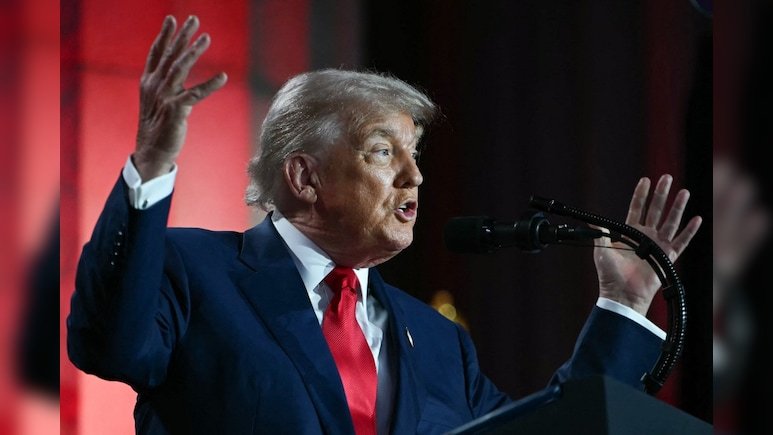
At the AI Summit held in Washington on Wednesday, former U.S. President Donald Trump strongly criticized leading American tech firms—including Google, Microsoft, and Apple—for hiring workers from India and outsourcing manufacturing operations to China. In his address, Trump urged these companies to shift focus back to American soil by creating domestic jobs and reducing dependence on foreign labor and infrastructure.
“Those days are over,” Trump declared. “Many of our largest tech companies have reaped the blessings of American freedom while building their factories in China, hiring workers in India, and slashing profits in Ireland. All the while, dismissing and even censoring their fellow citizens right here at home. Under President Trump, those days are over.”
Trump’s comments reflect a broader call for what he described as a “patriotic approach” to technological development and employment. “We need U.S. technology companies to be all in for America. We want you to put America first. You have to do that. That’s all we ask,” he stated.
Three Key Executive Orders to Boost U.S. AI Leadership
In conjunction with his remarks, Trump announced the signing of three major executive orders intended to solidify America’s global leadership in artificial intelligence. These initiatives form the core of his ‘America First’ tech policy.
-
“Winning the Race” Initiative:
This first executive order aims to accelerate the development of AI infrastructure in the United States. It proposes reducing red tape for the construction and operation of data centers and digital facilities, positioning the U.S. as a more agile competitor in the global AI race. -
Neutrality in Federally Funded AI Projects:
The second executive order mandates that AI systems developed with government funding must remain ideologically neutral. “We are getting rid of woke,” Trump said. He emphasized that AI must prioritize accuracy over political ideology and criticized earlier policies that he claimed hampered innovation through a focus on diversity and inclusion. -
AI Export Control and Supply Chain Independence:
The third order targets reducing reliance on foreign platforms and supply chains by promoting domestically produced AI solutions. It includes stricter export regulations on advanced AI technologies developed in the U.S., thereby securing intellectual property and national interests.
A Renewed Tech Doctrine Amid Global Competition
Trump stressed the strategic importance of winning the AI race, likening it to a modern-day space race. “America is the country that started the AI race, and as President of the United States, I’m here today to declare that America is going to win it,” he said. “Winning this competition will be a test of our capacities unlike anything since the dawn of the space age.”
Concerns for Indian Tech Talent and Global Implications
Although no direct policy changes have been announced regarding foreign workers, Trump’s remarks add to the growing unease among Indian professionals in the U.S. technology sector. Indian workers constitute a large portion of the American tech industry workforce, particularly in fields like software engineering, data science, and AI research.
The implications of an “America First” stance on AI development and employment are far-reaching. If followed by tighter immigration rules or funding restrictions for companies hiring foreign talent, it could disrupt career prospects for thousands of Indian engineers and developers.
Conclusion
Donald Trump’s aggressive rhetoric and executive orders mark a pivotal moment in U.S. tech and AI policy. While the emphasis on domestic job creation and infrastructure aligns with national interests, the stance raises concerns about global collaboration and the future of foreign professionals in America’s innovation economy. Whether this bold shift will truly strengthen American leadership in AI or create new barriers remains to be seen.